From spreadsheets to connected growth: Why life sciences needs a modern CRM
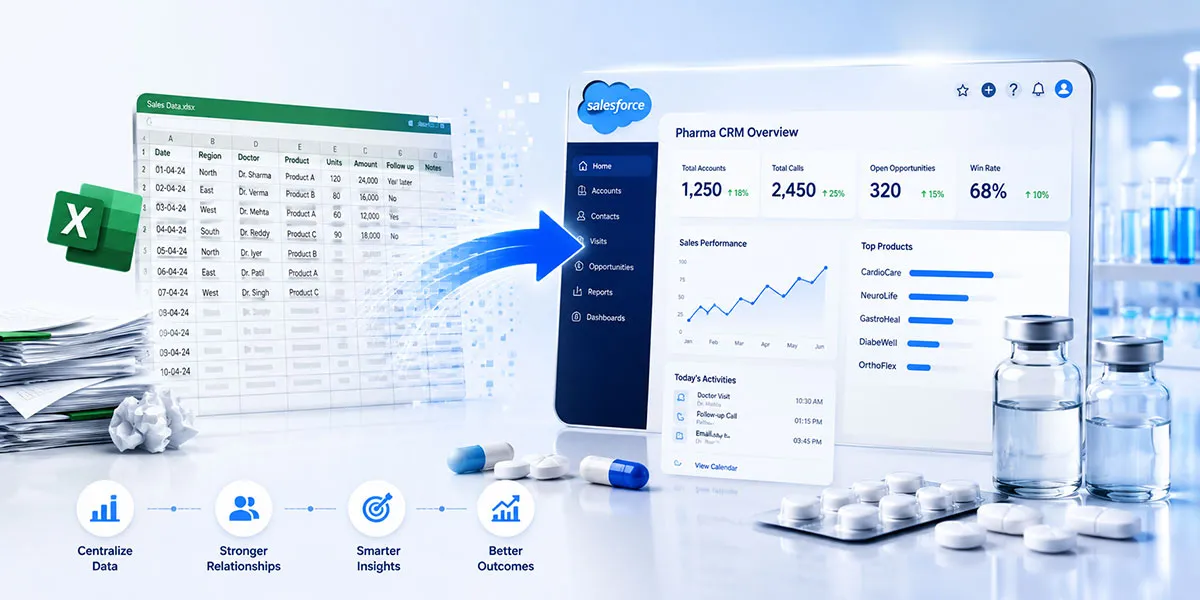
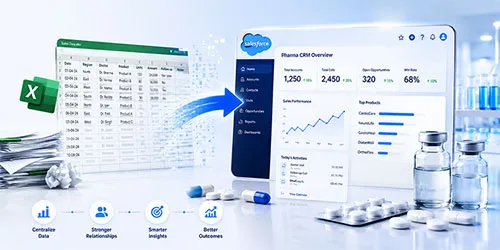
Life sciences companies can have some of the world's most sophisticated laboratories and manufacturing operations, while still managing critical commercial relationships through spreadsheets, emails and individual follow-up lists.
For a small team, that may work.
As the business grows across products, markets and geographies, the cracks begin to show.
A sales representative has one version of the customer. A manager has another. Finance is waiting for an update. The supply chain learns about an opportunity later than it should. Leadership is trying to forecast revenue using information collected from several different files.
So the problem is that the business has outgrown the way information moves through it.
Growth needs a shared view of the customer
Consider a pharmaceutical or CDMO business working with customers across different countries.
A single opportunity may involve sales, technical teams, quality, regulatory functions, finance and supply chain before it becomes revenue.
When customer information is distributed across emails and spreadsheets, every handoff introduces another opportunity for delay or lost context.
A modern CRM creates a common environment where teams can see the customer relationship, opportunities, activities and next steps.
That changes some very basic questions.
Instead of: "Who spoke to this customer last?", teams can see the interaction history.
Instead of: "Which spreadsheet has the latest forecast?", leadership can work from a shared view.
Instead of relying on someone to remember the next follow-up, workflows can help ensure that important actions don't disappear into inboxes.
Better visibility can change the commercial conversation
One of the biggest limitations of spreadsheet-driven processes appears when management needs to look ahead.
Which opportunities are progressing?
Where are deals slowing down?
Which customers need attention?
What does the pipeline look like by geography, product or account?
Which activities are actually contributing to conversion?
When data is captured consistently in a CRM, dashboards and analytics can turn everyday commercial activity into useful management information.
The conversation starts moving from collecting data to making decisions from it.
Life sciences adds another layer: Trust
Life sciences organizations operate in environments where governance, security and traceability matter.
That makes the way customer and commercial information is managed especially important.
Modern life sciences platforms can provide structured access controls, workflows, activity histories and governed processes while connecting commercial teams with the broader organization.
Salesforce's current Life Sciences platform, for example, is designed to support Pharma, MedTech and other life sciences organizations across clinical, medical, commercial and patient services functions.
The technology, however, is only one part of the decision.
The larger question is whether the organization is ready to replace fragmented processes with a connected way of working.
And then comes AI
AI makes the need for good foundations even more important.
Lead prioritization, intelligent recommendations, automated summaries and next-best actions can make commercial teams more productive.
But AI is only as useful as the information and processes around it.
If customer information remains incomplete, inconsistent or scattered across individual files, adding AI simply places intelligence on top of fragmentation.
The better sequence is:
Connect the Data → Establish the Process → Create Visibility → Introduce Intelligence.
Modernization is ultimately a business decision
Moving away from spreadsheets shouldn't be viewed simply as replacing Excel with CRM software.
It is an opportunity to rethink how information travels through the commercial organization.
For growing life sciences companies, that can mean:
- One shared view of customers and opportunities
- Better collaboration between commercial and operational teams
- Greater pipeline and forecasting visibility
- More consistent customer follow-up
- Stronger governance of commercial information
- A foundation for automation, analytics and AI
Spreadsheets are excellent tools.
But they simply weren't designed to become the commercial operating system of a growing life sciences organization.
So as businesses scale, we need to verify: "What could we do differently if the entire organization worked from the same information?"
That is where meaningful digital transformation begins.
More insights
Explore more perspectives on enterprise transformation, technology modernization, and business innovation.